Custom-Machined Ceramic Fiber Components: The Key to Reliable Refractory Interfaces
Custom-Machined Ceramic Fiber Components: The Key to Reliable Refractory Interfaces
A refractory lining is a system of materials, movements, and interfaces. And the interface is where standard products often fall short. Custom-machined ceramic fiber components can bridge that gap — literally.
Industry consultant Mohammad H Akbari recently wrote: "A good refractory design does not only ask: 'Is this material suitable?' It also asks: 'How will this material behave next to the material beside it?'" That small difference in thinking has a large impact on refractory performance.
At FOVO Thermal, we manufacture ceramic fiber boards, polycrystalline mullite fiber boards, and alumina fiber boards — but we also machine them into custom components that make interfaces work. Here's how.
Why Standard Products Fail at Interfaces
Standard ceramic fiber boards come in fixed sizes and simple shapes. At an interface, you often need:
- A board with a specific stepped edge to overlap a castable section
- A hole precisely located for an anchor or thermocouple
- A curved surface to match a cylindrical furnace shell
- A compressible layer with a specific thickness for an expansion joint
- A complex shape that fits between a brick and a fiber module
Cutting a standard board on site can work in some cases, but it rarely achieves the tolerances needed for a reliable interface. And for high-temperature applications, field cutting can damage the fiber structure and reduce performance.
What Custom Machining Can Do
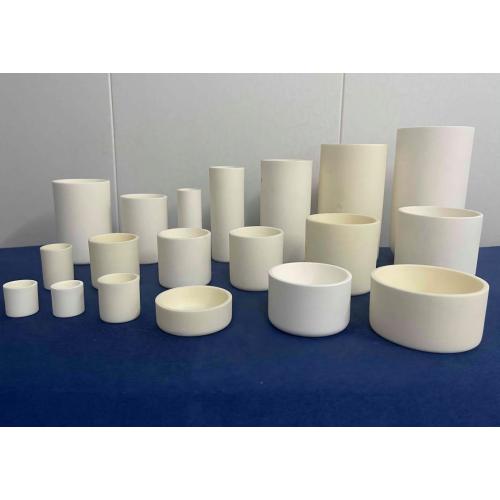
Custom-machined ceramic fiber components solve these problems by delivering exactly the shape and tolerance required.
| Interface Challenge | Custom Solution |
|---|---|
| Thermal expansion mismatch | Machined expansion joint with precise gap width |
| Mechanical restraint | Stepped or slotted board to allow movement |
| Anchor placement | Holes drilled at exact locations |
| Lining thickness change | Tapered or stepped boards |
| Complex geometry | Vacuum-formed shapes |
The FOVO Thermal Advantage
We offer custom fabrication with the flexibility that interface engineering demands:
- No minimum order quantity — one piece or one hundred
- ±1mm dimensional accuracy — critical for tight interface fits
- Vacuum forming — for complex shapes that cannot be machined from flat board
- Binder-free and pre-fired options — for inert atmosphere and vacuum furnaces
- Material selection support — we help you choose the right grade for the interface
We work from your drawings — CAD files, sketches, or even photos with dimensions. Our engineers review every drawing for manufacturability and interface performance before production.
Case Example: Glovebox Furnace Insulation
A recent project shows how custom machining solved an interface problem. A university research group needed insulation components for a small furnace operating inside an inert-atmosphere glovebox. The furnace ran at 600–800°C, but the environment demanded binder-free material to avoid outgassing.
The interface requirements were:
- Custom dimensions to fit a compact glovebox space
- Precise holes for heating elements and thermocouples
- Binder-free or pre-fired material
- Single-piece construction for the top and bottom insulation
- No minimum order quantity
We recommended a polycrystalline mullite fiber board with binder-free processing, manufactured the components to specification, and delivered them without requiring the customer to order excess inventory.
How FOVO Thermal Can Help
At FOVO Thermal, we manufacture ceramic fiber boards, polycrystalline mullite fiber boards, and alumina fiber boards — and we machine them into custom components that make interfaces work.
We offer:
- Custom sizes with no minimum order quantity
- Precision machining to ±1mm
- Vacuum-formed shapes for complex interfaces
- Binder-free and pre-fired materials for special atmospheres
- Free drawing review and interface consulting