Why High-Temperature Furnace Manufacturers Choose Polycrystalline Mullite and Alumina Fiber Boards for 1700°C+ Furnace Lines
Why High-Temperature Furnace Manufacturers Choose Polycrystalline Mullite and Alumina Fiber Boards for 1700°C+ Furnace Lines
Once a furnace operating temperature exceeds 1700°C, lining material selection stops being a question of "which one is cheaper." Standard aluminosilicate fiber boards undergo noticeable crystalline phase transformation at this range — the transition from glassy state to mullite crystals is accompanied by volume shrinkage, which leads to lining cracking, spalling, and a sharp drop in insulation performance. For OEMs building 1700°C+ furnaces, choosing the wrong material means reworking the entire furnace.
Three Requirements for Lining Materials Above 1700°C
First, crystal structure stability. Standard aluminosilicate fibers begin to crystallize above 1200°C and shrink rapidly above 1400°C. Polycrystalline mullite fibers maintain a stable crystal structure up to 1600°C, while alumina fibers can be used stably up to 1800–1900°C. This is not simply a difference in temperature ratings — it is a fundamental difference in whether the material can maintain structural integrity at high temperature.
Second, high-temperature shrinkage control. The linear shrinkage of a lining board during long-term high-temperature service directly determines lining life. Excessive shrinkage creates gaps between boards, and the thermal bridge effect raises the furnace shell temperature and increases energy consumption. Furnace lines above 1700°C typically require shrinkage rates within 1%, which high-purity alumina fiber systems can achieve at the hot face, with polycrystalline mullite used in back-up layers.
Third, purity requirements. During sintering or heat treatment, impurities in the lining material may volatilize at high temperature and contaminate the workload or atmosphere inside the furnace. High-purity alumina fibers contain over 99% Al₂O₃, and polycrystalline mullite fibers also have far lower impurity levels than standard ceramic fibers. This is a key reason why high-end high-temperature furnace manufacturers choose these materials.
Application Differences Between 1600°C Polycrystalline Mullite Board and 1800–1900°C Alumina Fiber Board
These two materials are not simply a "higher or lower temperature" relationship — they correspond to different furnace types and operating conditions.
1600°C polycrystalline mullite board is suitable for furnace chambers operating at approximately 1450–1500°C, or as a back-up layer in higher-temperature furnace lines. This range is common in high-temperature sintering furnaces, certain atmosphere furnaces, and high-end laboratory furnaces. Polycrystalline mullite fiber offers excellent thermal stability and thermal shock resistance below 1600°C, making it a cost-effective choice for this temperature range. It can also be used as a back-up layer in higher-temperature furnaces, where the hot face is exposed to higher temperatures but the back-up layer operates at a lower temperature.
1800–1900°C alumina fiber board is suitable for the hot face of furnace chambers operating at 1650–1800°C. This range is common in ultra-high-temperature sintering furnaces, specialty ceramic sintering furnaces, and the hot-face lining of certain vacuum furnaces. The crystal structure of alumina fiber board remains stable above 1800°C, making it one of the few fibrous materials that can be used long-term at this temperature.
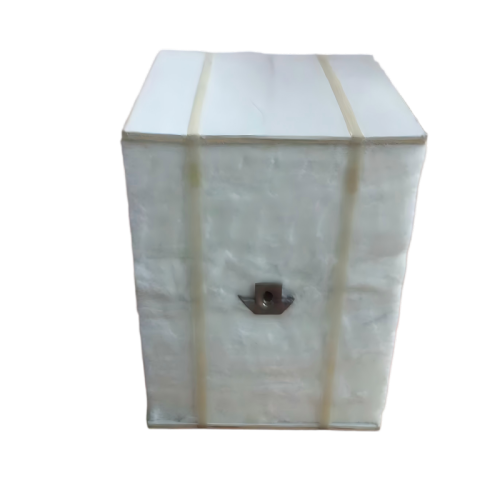
It is worth noting that many high-temperature furnace manufacturers use hybrid structures in their product lines. For example, in furnace chambers operating at 1650–1750°C, the hot face should use 1800°C or 1900°C alumina fiber board, while the back-up layer can use 1600°C polycrystalline mullite board. Modules such as 1430°C or 1600°C may be used for the roof and irregular areas. The design logic behind this hybrid structure is: the hot face uses a material with a matching temperature rating, while the back-up layer uses a lower-grade material to optimize cost without compromising performance.
Material Selection Decision Framework for Furnace Manufacturers
Step one: determine the maximum operating temperature of the furnace. This is the starting point for all material selection decisions.
Step two: reserve a safety margin. Typically, the classification temperature of the lining material should be 100–200°C higher than the maximum operating temperature of the furnace. In other words, a furnace operating at 1650°C should use a material with a classification temperature of 1750–1800°C. This margin accounts for temperature fluctuations, local overheating, and material aging over long-term use.
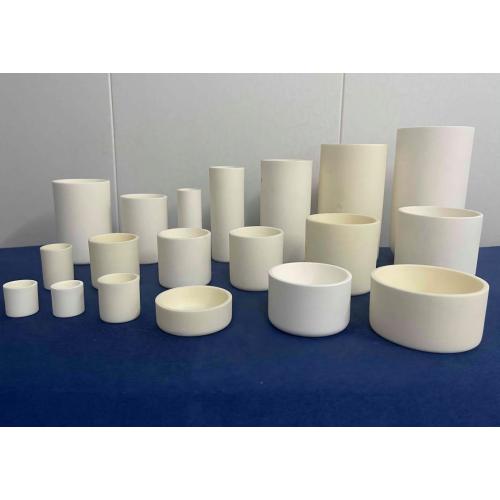
Step three: choose the product form based on furnace chamber geometry and heating element layout. Boards for walls, modules for roofs and irregular areas, alumina tubes for thermocouple protection, and crucibles for melting scenarios. This is also why the procurement list of a high-temperature furnace manufacturer usually includes more than just boards.
The Critical Role of Dimensional Accuracy in High-Temperature Furnace Linings
Furnace lines above 1700°C have higher requirements for lining dimensional accuracy than low- and mid-temperature furnaces. The reason is that high-temperature shrinkage widens the gaps between boards. If the initial installation accuracy is insufficient, the gaps after shrinkage become even larger, and the thermal bridge effect becomes more severe. A machining tolerance of ±1mm means the gaps in the lining can be controlled within a smaller range at high temperature, which is a prerequisite for long-term stable lining operation.
Vacuum forming combined with CNC finishing allows furnace manufacturers to provide furnace chamber drawings directly and receive lining components machined to the required dimensions and shapes, without on-site secondary cutting. For furnace lines above 1700°C, on-site cutting not only wastes material but also creates microcracks on the cut surface. These microcracks propagate at high temperature and affect lining life.
Conclusion
The core logic of lining material selection for 1700°C+ furnace lines is the stability of the material's crystal structure at the target temperature. Polycrystalline mullite and alumina fiber boards have become the first choice for high-temperature furnace manufacturers not because they are "more expensive" or "more premium," but because at this temperature range they are among the few material systems that simultaneously meet the requirements for structural stability, low shrinkage, and high purity.
When selecting materials, furnace manufacturers are advised to start from the maximum operating temperature, reserve a safety margin, and then determine the product form and dimensional accuracy requirements based on the furnace chamber structure. Once these three steps are defined, the material solution becomes largely clear.